


Core and back strengthening for back pain- from a physical therapist
- Feb 14
- 4 min read
Updated: Mar 4
One of the most important things you can do for back pain is strengthen your core. Your core/abdominal muscles act as a natural girdle that holds your spine up, and if your core is too weak, your back will feel more pressure from your joints holding you up instead of your muscles. It’s important to strengthen your core and back extensor muscles regularly to prevent and recover from back pain. (Please remember to always consult your doctor or a physical therapist in person for testing and diagnosis!)
Here are some of my favorites!
Pelvic Tilts
These are a great starting point to ensure you know how to activate your core. It’s a very small movement with the goal of getting your abs to fire. Lying on your back with your knees bent, act like there is a bug underneath your back and you want to squish it (gross analogy, but it's just an effective way to get the right movement). Your hips should tilt back and your low back should flatten to the ground. Your bottom should not come off the ground. Hold this for 5 seconds and repeat 10-20 times.

Supine toe taps/dead bugs
I love this one because you can start it off very easy/gentle and progress as your core gets stronger and you need more of a challenge.
Start on your back with your hands by your sides and your knees bent up in table top (hips and knees bent to 90 degrees). Then, keeping a pelvic tilt (see above), lower one toe down until it touches the floor as close to your bottom as you need. Then bring that foot back up and repeat on the other side, and continue alternating. If this feels too easy, tap your toe farther away from your bottom. You can keep progressing this by tapping your toe farther and farther away from you until you end up just straightening your knee. The final progression is adding your arms, where you have your arms straight up to the sky and as you lower one leg, the opposite arm reaches over your head/elbow and lowers to your ears. Keep that core activated the entire time by holding a constant pelvic tilt!


Bridges
A classic core activation and glute strengthening exercise, start on your back with knees bent and feet on the floor. Lift your butt off the floor until your torso and thighs are a straight line. Go slow and hold the highest position for 5 seconds. To make this harder, do it on one leg only with the other knee either straight or with your ankle crossed over your opposite knee.

Heel Taps
This is a great one for middle ab activation and getting those obliques (side abs) working. On your back with your knees bent, lift your shoulders up off the floor and your fingertips on one hand to your heel. Your torso should move to the side a bit as you reach. Then do the other side and continue alternating.


Prone Supermans
On your stomach with your arms reaching overhead and legs straight, lift both your arms and legs off the floor, keeping all your limbs straight like you are superman flying through the air. This activates and strengthens those back extensor muscles.

Prone Swimmers
Similar to prone supermans, start in the same position laying on your stomach with arms straight overhead and legs straight. Then alternate lifting one arm and the opposite leg off the floor. You can go as fast or as slow as you want.

Clamshells
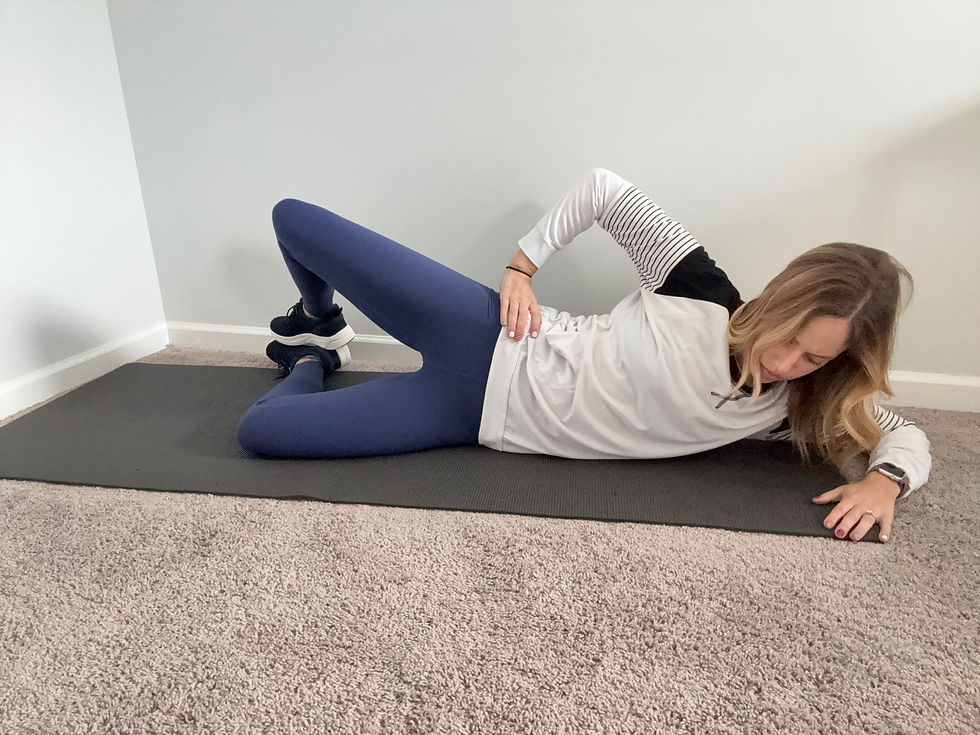
This will really test your hip abductor strength and mobility. Laying on your side with your hips bent about 45 degrees and knees bent 90 degrees, keep your ankles together while the top knee comes up as high as you can get it. Avoid rolling your hips and torso backward just to get more range. You want all the motion to come from the hips. To progress this exercise, add an exercise band tied around your knees.

Glute Kick Backs
Finally, activate those glutes some more! Start on hands and knees. Flex the foot on one side and kick the heel towards the sky. This can be made harder by adding ankle weights or tying an exercise band around both of your knees.


Preventing or treating low back pain often requires core strengthening. Some people (including yours truly) have back pain simply because their spine is hypermobile (joints move more than normal), and having a weak core causes their body to rely on their joints to hold them up, which can result in back pain with prolonged standing or sitting without support.
Maintaining core strength is essential to supporting your spine. Try out these once per day for a few weeks and see how your standing and activity tolerance change! Remember to always be monitoring your body for pain and to never push through pain. Also, check out my post about stretching for back pain to complement these strengthening exercises!
Always remember to keep moving! Motion always matters.

Comments